
The Best Booking System for Solo Nail Techs (What to Look For)
Hacado Team|November 20, 2026|9 min read|No comments
When you are a solo nail tech, your hands are never free when you need them.
You are mid-fill when the phone buzzes. A new client sends a DM asking if you have anything Thursday. Someone texts at 9pm to cancel tomorrow's full set. You answer all of it between clients, on your own time, from a notes app and a paper calendar that has seen better days.
It works, until it does not. A missed message becomes a lost client. A forgotten appointment becomes an awkward apology. A no-show on a three-hour set becomes a hole in your week that nobody pays for.
A booking system fixes most of this, but only if it fits how a solo nail tech actually works. This guide covers what to look for, what to skip, and how to get set up in an afternoon.
Why DMs and Texts Stop Working
Back-and-forth messaging feels personal and free. It is neither, once you add up the cost.
Roughly 37% of business calls go unanswered, and for a solo tech with her hands in gel, that number is probably higher. Every unanswered call or slow reply is a client who may book with whoever answers first.
There is also the clock. Around 46 to 50% of salon bookings happen when the salon is closed. Clients decide at 9pm on a Tuesday. If the only way to book you is to wait for you to reply tomorrow, some of them will not wait.
A booking page works while you sleep, while you work, and while you are on vacation.
What a Solo Nail Tech Actually Needs
Booking software for big multi-location salons is built around things you will never use. For a solo tech, a short list of features does almost all the work.
1. A Service Menu That Reflects Real Time
Nail services are not one-size-fits-all. A removal plus a full set plus nail art is a very different appointment from a basic gel manicure, and clients cannot always judge how long it takes.
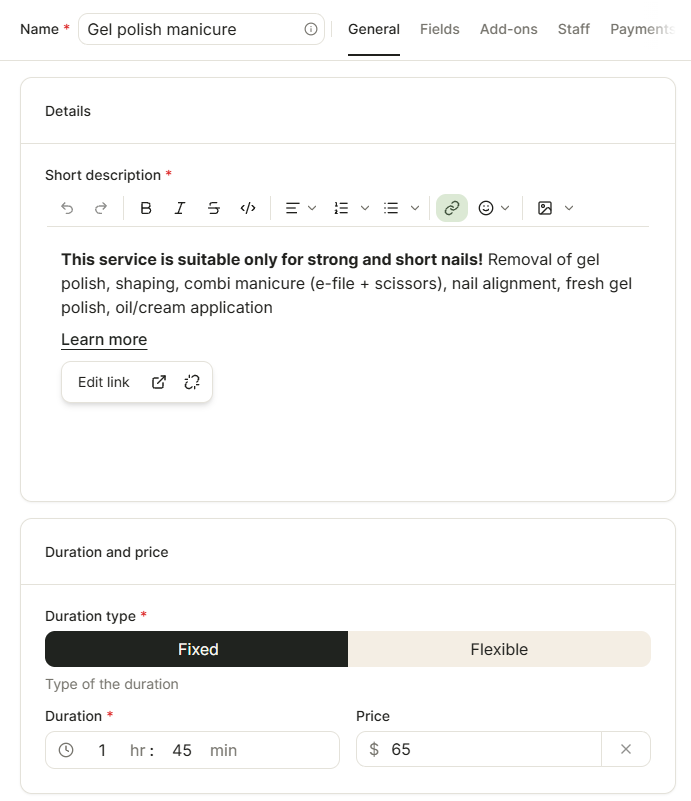
Look for a system where each service has its own duration, price, and description. Add cleanup and reset time into the duration itself, so back-to-back bookings do not leave you scrambling to sanitize your station.
A good description saves you messages too. "Full set, gel extensions, includes shaping and one color. Art is extra. About 2.5 hours" answers three questions before anyone has to ask.
2. Deposits for Long Appointments
This is the single most useful feature for a solo tech, and the reason is simple math.
Say you book two full sets a day at $90. If one client a week does not show up, you lose the $90 and a 2.5-hour slot that is hard to refill. That is about $4,680 a year from one missed appointment a week.
Deposits change client behavior. Industry data puts nail salon no-show rates at 20 to 25% without deposits and 4 to 6% with them. Even if your real numbers are better than that, the direction is clear: when a client has money on the line, they show up, or they warn you early enough that you can fill the slot.
A simple rule many techs use:
No deposit on short services under an hour
A deposit of roughly 20 to 30% of the price on full sets, nail art, and anything over two hours
Whatever system you choose, check that it lets you set a deposit per service. You do not want to ask for $25 up front on a $30 polish change.
A note on fees: when a client pays a deposit online and the rest in person, those are two separate card payments, and your payment processor charges a fee on each. The booking platform should show you what each payment cost so you always know what you actually earned. Also ask whether the platform adds its own fee on top of the processor's. Hacado does not.
3. Cancellation and Reschedule Rules That Run Themselves
Here is a detail that surprises many techs: nail salons see far more cancellations than true no-shows, around 16% cancellations against 1% no-shows. Most clients do not vanish. They cancel, often late.
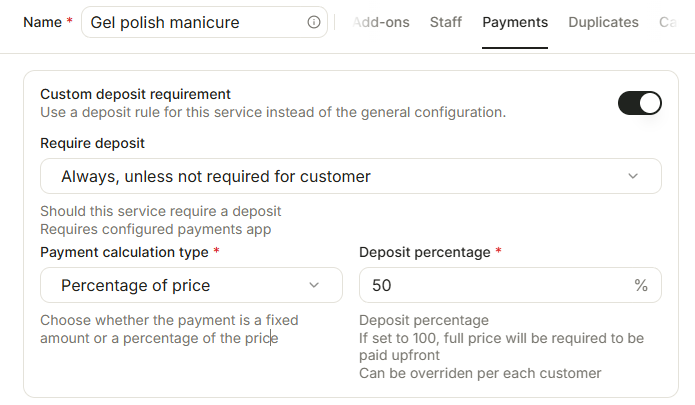
That means the policy matters more than the deposit alone. You want a system where you set the rules once, such as full refund with a week of notice, partial refund inside that window, deposit forfeited inside the last few days, and the system applies them automatically every time. No awkward texts, no deciding case by case when a client has a good story.
Look for time-based rules and the ability to set different rules for different services. A quick polish change and a four-hour set should not follow the same policy. We cover how to write one in our guide to cancellation policies.
4. Reminders That Send Themselves
Most missed appointments are forgotten appointments. An automated reminder a day or two before, and another closer to the time, recovers a large share of them. Clients can also use the reminder to confirm, reschedule, or cancel early, which gives you a chance to refill the slot.
If you take most of your bookings from Instagram followers who have never met you, reminders matter even more. New clients are the most likely to forget.
5. A Booking Link That Works Everywhere
For a solo tech, the booking link is your front door. It needs to live in your Instagram bio, your Google Business Profile, your text signature, and on your business card.
Two things make that link work harder:
It should look like yours. A booking page with your name, your colors, and ideally your own web address feels like a real business. A generic third-party URL does not. If you are thinking about a custom domain, we have a full guide on choosing one.
It should be fast on a phone. Over 80% of salon bookings happen on mobile, usually with one thumb. If the page is slow or fiddly, clients give up.
6. Clear Costs With No Surprises
Booking software for beauty pros comes in two main flavors.
Marketplace apps put you in a directory where new clients can find you. That can help, but it often comes with fees on those new clients. For example, one popular marketplace takes 30% of a new client's first appointment, up to $50, and adds a booking fee for the client.
Your-own-brand tools give you a booking page that belongs to you. You bring the clients, from Instagram, Google, or word of mouth, and keep all of the money minus payment processing.
Neither is wrong. But know which one you are signing up for, and read the pricing page for fees that scale with your success. Monthly costs for a solo tech currently range from $0 to about $35 before card processing and marketplace fees, so the sticker price is rarely the whole story.

What You Can Safely Skip
A solo tech does not need most of what big salon software sells. You can skip:
Multi-location management. You have one table.
Complicated staff scheduling and commissions. You are the staff.
Heavy inventory tracking. A simple note of what is running low is enough.
Built-in marketing suites. Your Instagram and your regulars do that job better.
Extra features are not free. They add clutter to the screens you use every day. The best system for a solo tech is the one you will actually open between clients.
Rebook at the Chair, Not Later
One habit beats any feature: ask every client to rebook before they leave.
Top-performing salons rebook about 35% of visits at checkout, while the average is only around 9%. The difference is process, not talent. Your regulars already know they need a fill in two or three weeks. Offering a specific time while they are still admiring their nails is the easiest booking you will ever get.
A booking system makes this effortless. Pull it up on your phone, offer two times, tap, done. The reminder system takes care of the rest.
A Checklist for Comparing Booking Tools
Use these questions when you compare options:
Question | Why it matters |
|---|---|
Can I set a different duration and price per service? | Nail services vary a lot in time |
Can I require a deposit on some services but not others? | Deposits belong on long sets, not quick services |
Can I set time-based cancellation rules? | The policy runs itself |
Do reminders send automatically? | Fewer forgotten appointments |
Is my booking page branded as mine? | Clients trust it more and remember you |
Are there fees on top of card processing? | Costs should be predictable |
Can I take payment with the processor I already use? | No need to change how you get paid |
Is it easy to use from my phone? | You will mostly use it between clients |
Getting Set Up in an Afternoon
Here is how the setup looks in Hacado. Other tools follow a similar order.
1. Add your services. Create each service with its duration, price, and a short description. Start with your top three or four.
2. Set your hours. Add the days and times you actually take clients, plus any days off.
3. Connect your payment processor. Hacado works with Stripe, Square, or PayPal. Stripe and Square connect with a login and a confirmation, much like linking a calendar. You use one processor at a time and can switch later.
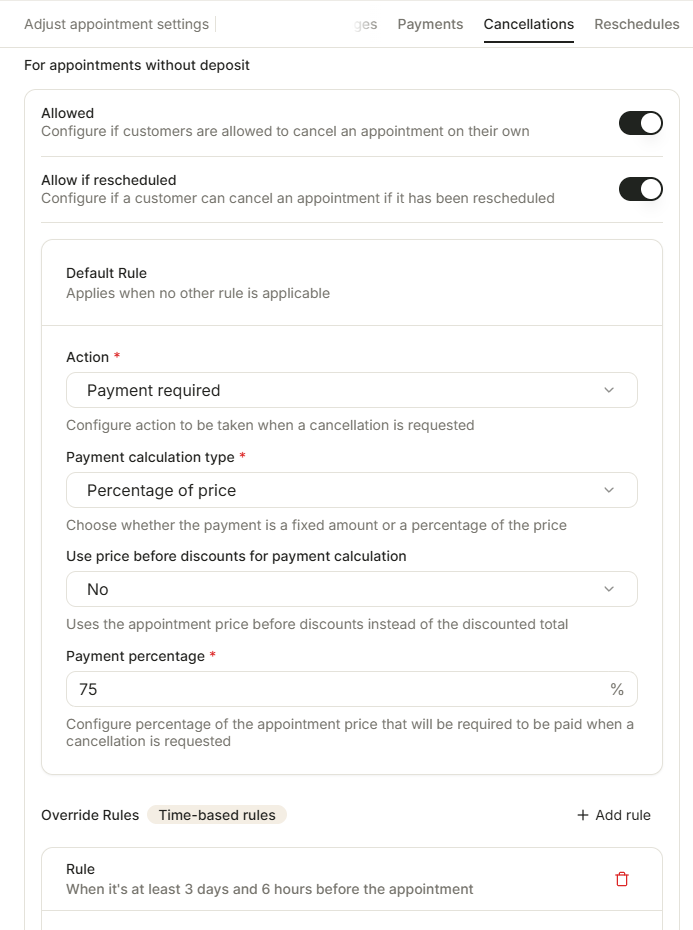
4. Set your deposits. Turn on deposits for your longer services and leave short ones without.
5. Set your cancellation rules. Go to Settings, then Appointments, then Cancellations to build your time-based rules. You can also set rules for a single service from the service's own settings.
6. Share your link. Add it to your Instagram bio, your Google Business Profile, and your messages. When someone DMs "do you have anything Friday?", reply with the link.
Most techs get through all six steps in an afternoon, and the first booking often arrives that same week.
The Bottom Line
Running a solo nail business means doing everything yourself, but not everything needs to be done by you. The right booking system takes over the repetitive parts, such as answering the same questions, chasing deposits, sending reminders, and applying your cancellation policy, so your attention stays on the client in front of you.
Look for per-service deposits, rules that apply themselves, automatic reminders, a branded link, and pricing you can read without a calculator. Skip everything that was built for a bigger salon than yours.
If you want to try it, Hacado is built for exactly this kind of business.
Have questions about setting up your booking page or deposits? Leave a comment below or reach out to our support team.
No comments yet. Be the first to comment.
Add comment
hacado
Hacado gives independent beauty & wellness businesses a beautiful booking website without the ugly software.
© 2026 Hacado. All rights reserved.